SLARVATHOffice of Off-World Correspondence

Nothing here is pinned to anything

The visitor publication

Carried folded. Split at the second crease.

Welcome back to Slarvathia

You have been here before. We have not moved.

Bureau of Returning Persons · issue not stated · complimentary

This publication assumes your return. No provision is made for a first arrival, which is a lesser occasion and is not addressed here.

Say verrin on the step. You will have been expected.
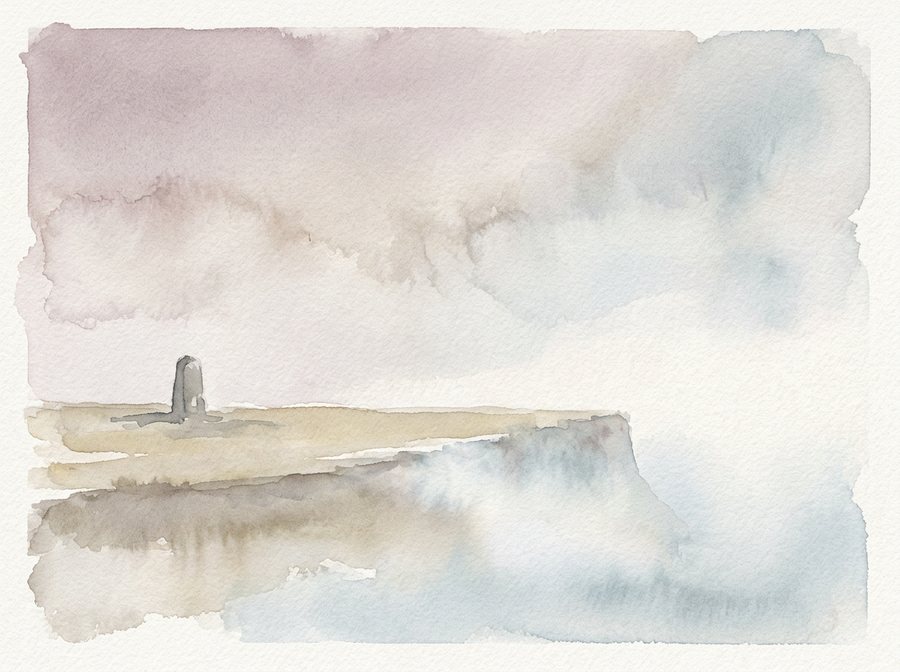
A pale watercolour of a wide flat plateau ending at a cliff, with fog rising from below and spilling over the edge, a single low stone marker at one side
The Shelf, Morning — Hesk Varrow. Held at Thur.

The Vennet Shelf

Grey, and always has been.

There is nothing to do here, and that is the reason to come.

The fog arrives from below in the morning, stays past the hour it should have gone, and thins in the late afternoon until the sun can be looked at directly. Three of the six occur daily. The others cannot be scheduled and are not advertised.

Bring nothing.
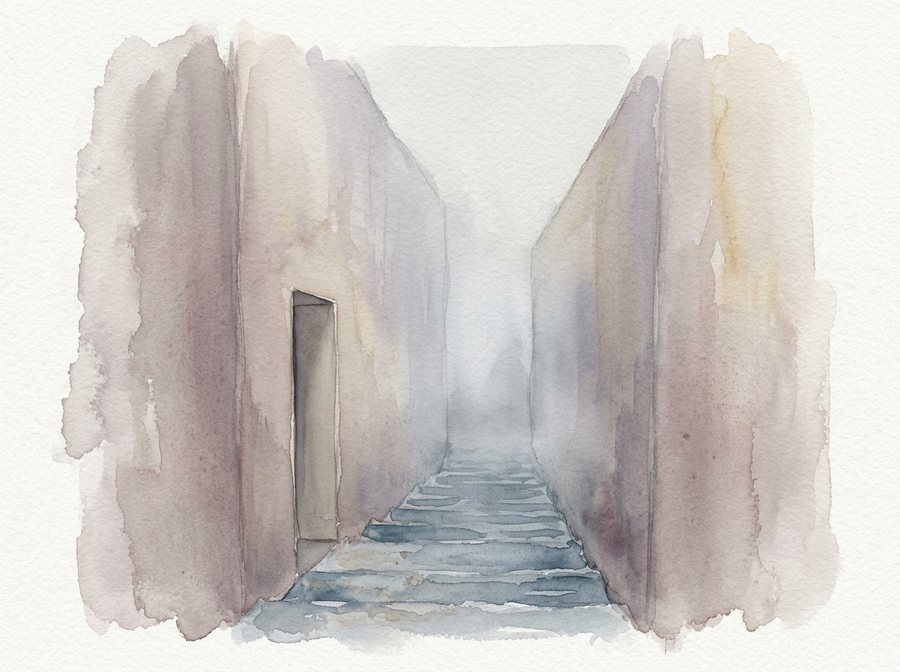
A pale watercolour of a narrow stair descending between two smooth monolithic walls into grey haze, with one plain rectangular opening in the left wall
Steps at Thur — Orrin Delleth. Held at Thur.

The Lowmarket at Thur

Audible from the step. Not visible.

Visitors are asked not to look for it.

Those who have found it report that finding it was not an improvement.

Open continuously. Closed on the Long Sitting.
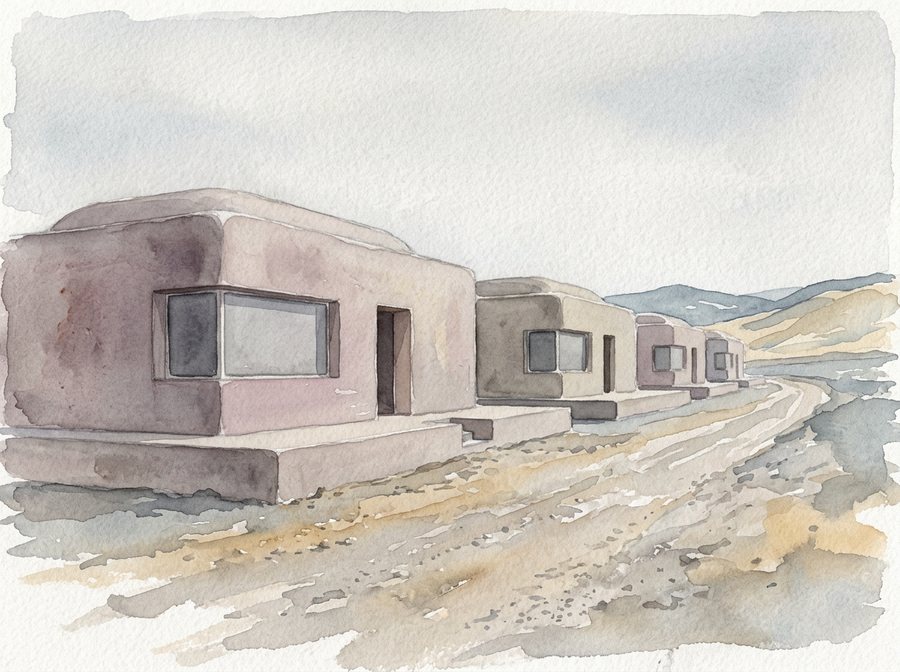
A pale watercolour of a row of low monolithic dwellings raised on continuous plinths beside an unpaved track, each a single smooth mass with a flat top and wide flush windows
Grieth, Unchanged — Munnet Sarr. Private collection.

Old Grieth

The oldest settlement, and the least altered.

Nothing here has been repaired in living memory, as nothing here has broken.

Visitors sometimes remark that the town appears to be waiting. It is not.

The Quiet Belt

No settlement. No road. No reason. Crossed in under two hundred kadd. Most visitors do not stop. Those who stop do not report why.

The Long Sitting

One full day annually on which nothing is permitted to happen. Arrangements must be made the night before, as no arrangements may be made on the day. The prohibition on repair extends to dwellings only.

Notices
Keeping
Thur, third level

We hold what you cannot carry.

Objects kept for the sake of the giver, held for as long as required. No inventory is published. No object is ever sold.

Terms are by the year and have not changed.

Hallow & Son
Benches

Sat upon since before the Bureau.

Not for sale. Come and sit.

The Belt Crossing
Departures from Grieth

Two hundred kadd, weather permitting, and the weather permits.

Passengers are asked not to request a stop. A stop cannot be arranged and has never been arranged.

Rooms for the Sitting
Vennet road

Arranged in advance, as they must be.

Food set out the night before. Nothing will be asked of you for one full day.

Personal

Seeking someone to sit near on the Long Sitting. No conversation required. I have my own bench.

Returning after some years. Would like to be recognised. I will be at the Lowmarket, where I always was.

Have an eskaleth belonging to someone. Have had it a long time. Would like to give it back.

Anyone who remembers the house on the Vennet road with the flat window — I am trying to establish whether it is still there.

Two of the six words I have never had occasion to use. Would like to use them once.

Not seeking anyone. Placed to see it printed.

Will be crossing the Belt on the ninth. Will not be stopping. Mentioning it in case.

Before you return

Two hundred kadd in every day. You will not need most of them.

A meal eaten standing up is impolite and will be noticed.

Objects kept for the sake of the giver need not be declared.

Say verrin on arrival. You will have been expected.
Office annotationThe document above is a visitor publication of uncertain date, issued by the Bureau of Returning Persons, a body since dissolved. The Office notes that the crossing time given for the Quiet Belt has been understated since publication, and that the premises advertised on the second page closed some years ago. A current edition has twice been offered to the Correspondent. He has twice declined.
Transmitted

From the Wrong Side

At home the growing ground is below the last step. You sit on the steps and you are looking at it. Nobody made it that way. The steps go down toward the fog because that is where the fog is, and the ground between the bottom step and the fog is where things grow, because that is where the fog stands longest, and that is all there is to it.

The ground is cupped. Each hollow holds one thing. On the low side of each there is a lip, poured, which keeps the fog in the hollow a little after it has gone down everywhere else. The lips wear and are poured again, in the mineral of the place, and the mend shows, so you can see which hollows are old. At Grieth there is more mend in the lips than stone.

Nobody waters anything. The fog comes up, from below, as it does, and the hollows take it, and it goes down again, and the dorrel is taken the same turn and the pellun is kept and the thrisk goes over the lip to meet the next one. That is the whole of it. I kept hollows when I was small, with whoever was looking after me that year, and I thought everyone everywhere did, in the way you think things when you are small.

Here there is a garden a few streets from my rooms, on a corner, with a gate that is not locked in the day. The ground inside is divided into boxes, raised, each with a low fence round it that a child could step over and a number on a stake. I was glad of the hollows at once. They are the wrong shape and they are up on legs, but they are hollows, one thing to each, kept by one household each, and I stood at the gate for a while just being glad.

I asked what the fences kept out. I was told nothing, they were so you knew which was yours. At home you know which is yours because you are the one keeping it. I did not say that. I said I saw.

Then a man came with a hose and watered his. I had not seen it done before and I did not understand it for a moment, and then I did, and I had to look at something else. The water went in from the top. It fell on the ground from above, onto the leaves and onto the soil, out of the air, where water does not come from. At home that would be the fog falling, and the fog does not fall. I said, as politely as I could, that I had not known water could be put on from that side. He said it was the only side there was. I said yes. I stayed until it had gone down into the ground, which took about ten minutes, and then it looked like a hollow again and I could look at it.

I have thought about it since. I think they do it because the fog here does not come up. There is nothing to take. So they bring the water to the hollow themselves, from the only side they can, and I think that is a kind of keeping too, done the hard way round. I would not say so to him. He has number fourteen, and it is doing well.

Office annotationCorrespondent SLV-4 refers to the ground below the steps, held on the Bureau's sheet at every place with a shore, and to three things grown in it, entered on Form 12 as he gives them and not rendered. The garden he describes is held in common and let out in plots by the year; the number on the stake is the plot's, and it is entered here as the name of the plot, which is what it is for. The water was supplied by hose. The stated interval of ten minutes is 1.49 kadd. The Correspondent's remark to the person holding the hose is entered as reported.

Far Enough Out

The night before, everyone stays at Senn. The rooms stand along the way out with their windows to it, and the tables are long, because nobody sits at one alone that night. I did not sit alone. There were more of us at the table than I had expected, and some I had not seen since I was small.

At home nobody is only yours. Whoever can look after the young ones does, and you grow up in and out of a great many houses, and when you go, the ones who looked after you walk you out. That is how you find out who they were. I had not counted them before. I counted them that night, at the table, and then I stopped, because it is not a thing you count.

In the morning the way runs west to the Shelf. It is the most walked ground there is. Everyone walks it once, and the ones who go with someone walk it twice in a day, out and back, so it is worn wider than any other way I know. Nobody built it. Nobody would.

The Shelf is flat and grey and there is nothing on it but the marker. You see it from a long way off and walk toward it, and it does not seem to come any nearer, and then it does.

At the marker they stop. The ground is worn bare in a ring there, from all the stopping. Nobody says anything at the marker. I had been told that and did not believe it, and it is true. They stood in the ring and I went on by myself. I did not look back, because you do not, and because I knew they would stand there a while yet and I did not want to see them turn.

Here there is a school on my way to the station. In the mornings the small ones are walked to the gate. Some come with one person and some with three, and some with somebody different every day of the week, and nobody at the gate seems to find that strange. At the gate the grown ones stop. The small ones go in.

One morning I stood across the street and watched until the bell. Twelve minutes. Most of them waited after the small ones had gone in. Not long. Long enough to be sure. Then they turned and walked back the way they had come.

I would have liked to tell them it is the right place to stop. I did not. I think they knew.

Office annotationCorrespondent SLV-4 refers to Senn and the Vennet Shelf, held on the Bureau's sheet, and to the way between them, held on Form 2, Schedule E, throughout. Those who walked out with him are not named. No names are entered. The Bureau gives Senn to the Shelf as one sull. A sull cannot be converted. The account gives nothing past the marker. The school he describes admits children from the age of five; they are customarily accompanied to its gate in the morning. The stated interval of twelve minutes is 1.79 kadd.

The Plume Ground

At Hesk the ground round Oddren is kept bare. Nobody sweeps it. It is bare because people stand on it, and they have stood on it for longer than there has been a house in the basin.

Oddren is not one thing. It is many, in one stone. The tubes come up out of the stone close together, ridged all the way up, and the stone has grown round them a little at a time for as long as anyone has looked. You tell how old it is by the stone. Nobody says a number. They say it is at least as old as something, and they name something old, and then everyone is quiet for a while, because that is the right answer.

When the fog comes up into the basin the others open, all along the shore. Oddren opens first. Not by much. You have to be watching. The plumes come up out of the tubes turning, two to a tube, and spread the way a hand does when it stops holding something, and they stay like that while the fog is high. Then they draw down, straight down, into the tubes, and the tubes are empty and you can see into them.

People watched that before anyone counted anything. The count is kept at Hesk now and it does not need Oddren to keep it. But the ground is still kept, and people still go and stand on it and wait for the first one, and nobody calls it work.

I went often. On the near side the ground is worn lower than the rest, from standing, and I liked to stand in it.

Here there is a plant in front of a house on my way to the station. It is low, with small flowers, yellow on some stems and a deep pink on others. In the day they are shut. I was told they are called four o'clocks because that is when they open. One evening I stood at the fence to see. I was there forty minutes. They opened at twenty to seven.

Nobody here seemed to mind. The name was given and it stayed. I think that is right. At home we let the thing open first and counted from it. Here they counted first and named the thing after. Either way somebody stood and watched it, once, for long enough to say.

Office annotationCorrespondent SLV-4 refers to the colony held on Form 2, Schedule D, as Oddren, against Plate 3. No row of Form 22 stands against the name. Its age is entered as he gives it, at least. The plant he describes is Mirabilis jalapa, called the four o'clock, whose flowers open in the late afternoon or evening and close by the following morning. The interval he stood at the fence, forty minutes, is 5.95 kadd. A related matter is held in Form 21.

The Passing

At home there is a path along the shore below the terraces, a little above where the fog stands, and it goes the whole way round the water. Nobody keeps it and nobody is asked to. It is there in the morning the way the fog is.

Once a year they come along it.

You hear about it before you see it. Word comes from further along the shore that the work has stopped there, and then a day or two later it stops where you are. Nobody is told to stop. The baskets are left on the terraces where they were set down and everyone goes up to the houses and sits in the windows.

They come in a line, five of them, and they do not hurry and they do not stop. Each one goes on one foot, the whole underside of it, and the ground is wet behind them. The front of each one is lifted a little and there are two stalks there that turn, one and then the other, and never together. Some of them carry a shell. There is a sound the whole time, long and low, like a cloth being drawn across stone and never reaching the end of it.

They do not look up. There is nothing above them they want.

Behind them the five lines cross and come apart and cross again, and they are bright. The near end is brightest. The far end goes dull first, and by looking at how far back the dullness has come you can tell how long it has been since they were there. I knew that before I knew anything else about them. I think everybody does.

The passing is over when the last line has gone dull the whole way along. Then the baskets are taken up. Nobody says how long that was, because it was a passing.

Nobody at home says the paths are theirs. It is not that nobody knows. You would not say whose a path was, any more than you would ask somebody what they came back with.

Here there is a line worn across the grass in the park on the way to the station, where people go the short way, and a small sign in the middle of it asking them not to. I stood and looked at the sign for some time. At home the line would have been entered and left.

I am a long way from anyone it would be rude in front of, so I will put it down once. The paths are theirs. I have watched them make them. I was small and I sat in the window the whole of a passing and did not look away, and the line below the house was bright the entire time, and it was still bright when I was put to bed.

Office annotationCorrespondent SLV-4 refers to the paths entered on the Bureau's sheet along the shores of the standing fog, a little above it. The Bureau has not attributed them and this Office enters them as it finds them. The Correspondent's account attributes them. It is entered as transmitted. Attribution is not a finding of this Office. The interval the Correspondent calls a passing is, on his own account, a sull, and cannot be converted. A related matter is held in Form 21.
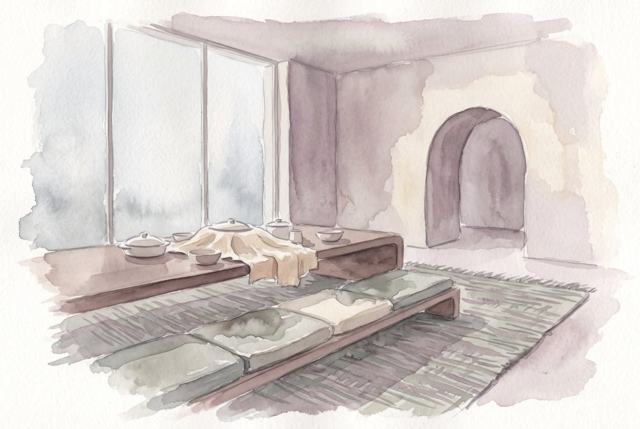
A watercolour of a low, wide room with backless benches and a long table of covered dishes, a tall window filled with pale fog, and two worn hollows in the cushions

The Long Sitting

At home there is one day each year on which nothing happens. This is not a failure of the calendar. It is arranged.

You may not work on the Long Sitting, but neither may you rest in a way that accomplishes something. You may not repair. You may not plan. My grandmother set out the food the night before so that even the food would require no decision from anybody. Then the household sits, each in whichever room they are already in, and the fog stands at the window higher than it does on other days, which is brenn, and the day goes by, and that is the whole of it.

I have tried three times to explain the Long Sitting to people here, and every time they have asked me what you do on it. I keep saying: nothing. They keep asking what else.

Ommet never understood it either. Ommet moved through the entire day, with ease.

I have painted the room the way it was, which is the only way I have left to sit in it.

Office annotationCorrespondent SLV-4 refers to the Long Sitting, observed annually across the northern settlements and lasting one full day. The Office notes that the prohibition on repair extends to dwellings only and has never extended to persons. The name given in the fourth paragraph does not correspond to any entry in the Correspondent's household record. No further comment is offered.