The Help
There is a phrase here for the person who keeps a house that is not theirs. They are called the help. It is not said kindly, usually, and not unkindly either. It is said the way you would say the plumbing.
I heard it in the front room of the restaurant, through the door, about somebody I have never seen. I have been turning it over since and I have decided that it is mine. I would like to be entered as the help. I have written to say so. I understand the Office will have a view.
What I do, when I am not at the kitchen, is keep the house. I shop for it. I cook for it, on the days I am not cooking for the other one. I clean it and I put things where they go. I know this is not a household, since it is only me in it. I keep it as if it were one anyway, because a house with nobody keeping it is only rooms, and I was not sent here to live in rooms.
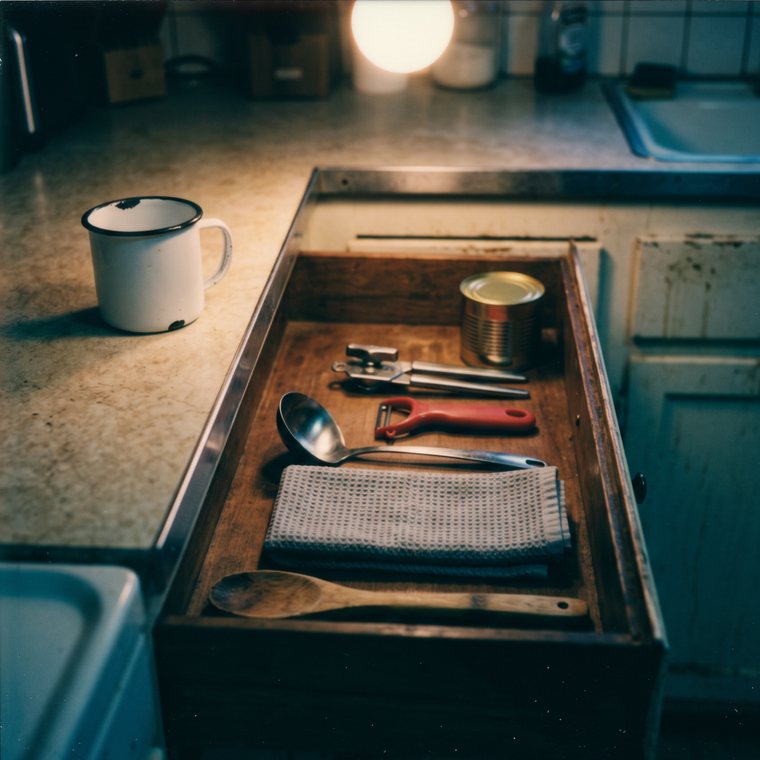
Here is the drawer.
When I arrived, the drawer was arranged by kind: the spoons with the spoons, the sharp things with the sharp things. That is how you arrange a drawer for a person who wants to find a thing. I have rearranged it by how long each thing is held. The wooden spoon is at the front, because it is held the longest, whole evenings sometimes, and the tin opener is at the back, because it is held for about as long as it takes to say its name, and the cloth is second because a cloth is held for a very long time in total if you count it properly, and I do. Nine hundred kadd, this week, for the cloth.
I know this is not how the drawer is meant to go. Nobody else opens it. That is what makes it mine to arrange, and it is also, I think, the entire job.
The help does not sit at the table. I know that too. I sit anyway, afterwards, at the head of it, because there is nobody to mind.